

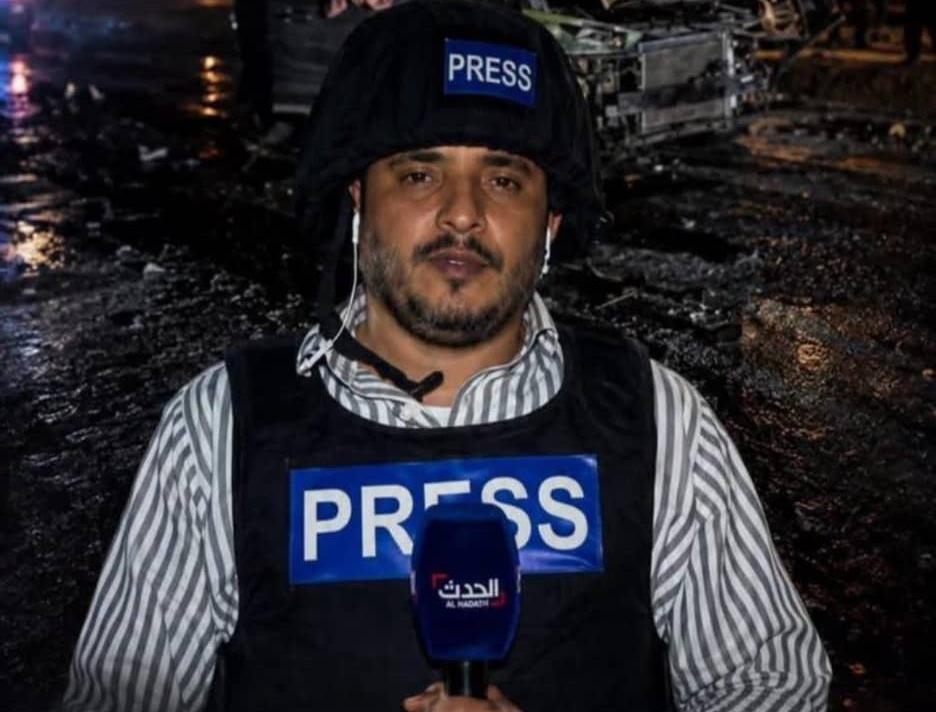
Yemen: Rights Radar Condemns Killing of Al-Arabiya and Al-Hadath Correspondent Mohammed Ayed in a Bomb Attack in Hadramawt The Hague, the Netherlands – June 26, 2026 Rights Radar for Human Rights, based in The Hague, the Netherlands, strongly condemns the Killing of Al Arabiya and Al Hadath correspondent Mohammed Ayed. He was killed when an explosive device planted in his vehicle detonated in the city of Mukalla, Hadramawt Governorate, eastern Yemen. This incident adds to a long record of systematic violations targeting journalists and media professionals in Yemen—a country that has endured the devastation and consequences of armed conflict for the past eleven years. Rights Radar emphasizes that this criminal act targeted not only the victim and the media outlets he represented but also constitutes a blatant assault on press freedom and the public’s right to access information. Mohammed Ayed had previously been subjected to harassment, surveillance, and threats by the Houthi militia while working in Sana’a as a correspondent for Alhurra TV. These pressures forced him to leave the capital Sana’a several years ago, making his killing the latest chapter in a long-standing campaign of persecution against him. This killing follows a recurring pattern of attacks against Yemeni journalists involving explosive devices. Journalist Rasha Al-Harazi was killed in the same manner in Aden Governorate on Tuesday, November 9, 2021; the bomb explosion also killed her unborn child and injured her husband, journalist Mahmoud Al-Atmi. Similarly, journalist Saber Al-Haidari—an employee of the Ministry of Information and a correspondent for Japan’s NHK Television—was killed in mid-June 2022 when an explosive device planted in his vehicle detonated in Al-Mansoura District, Aden. Like Ayed, Al-Haidari had left Sana’a in 2017 after facing intimidation by the Houthi militia. Earlier, on May 17, 2018, photojournalist Ali Abu Al-Haya died from injuries sustained earlier that month when an explosive device detonated while he and others were traveling between the districts of Hays and Al-Khawkhah, near Al-Hodeidah Governorate in the west of Yemen. These repeated, targeted attacks demonstrate the grave dangers facing journalists and media workers in Yemen—a country consistently ranked by specialized international organizations among the world’s most dangerous for those in the press. Since September 2014, dozens of journalists have lost their lives in Yemen under harsh and violent circumstances. Some have died under torture in Houthi detention centers, or shortly after their release due to the long-term effects of that torture and the denial of essential medical and psychological care. Others have been killed in airstrikes or while covering front-line fighting. Furthermore, several abducted journalists remain arbitrarily detained, with many still facing significant threats to their lives. In light of the above, Rights Radar calls for an immediate, transparent, and independent investigation into the killing of journalist Mohammed Ayed. The investigation must uncover all the circumstances surrounding the crime, identify those responsible for ordering, inciting, and carrying it out, and bring all perpetrators to justice, particularly in light of reports from people close to the victim that he had received threats only weeks before his killing. Rights Radar also calls on the Yemeni authorities to adopt immediate, practical, and effective measures to protect journalists and media professionals working in conflict-affected areas and to end the prevailing climate of impunity that encourages the recurrence of such crimes. Furthermore, Rights Radar calls on the international community, including UN Special Envoy to Yemen Hans Grundberg and organizations dedicated to press freedom, to condemn this crime and exert the necessary pressure on all the conflicting parties to ensure the protection of journalists. Finally, Rights Radar emphasizes the importance of documenting this crime as part of a comprehensive case file to be submitted to the United Nations Special Rapporteurs on the promotion and protection of the right to freedom of opinion and expression and on the protection of journalists, particularly in conflict situations.
25
Jun
2026

Comments 0